Catamaran vs Motor Yacht vs Sailing Yacht for Groups
By The Charter Cost Guide editorial team · Updated October 13, 2026 · 8 min read
Some links on this page are affiliate links. We may earn a commission at no extra cost to you. Read how we make money.
Short answer
For groups, catamarans usually win on space per dollar: a crewed sailing catamaran lists at a median of about $31,500 per week all-inclusive, versus about $118,800 for a crewed motor yacht before running costs. Motor yachts win on speed and range; sailing yachts win on sailing experience and lower fuel bills. All three are capped at 12 guests on crewed charters.
Groups choosing a first crewed charter usually narrow it to three options: a catamaran, a motor yacht, or a sailing yacht. They differ less in luxury than in physics — how the hull moves through water decides the speed, the fuel bill, the space and, in the end, the price. This guide compares the three on the dimensions that actually change a group trip, with published 2026 price data.
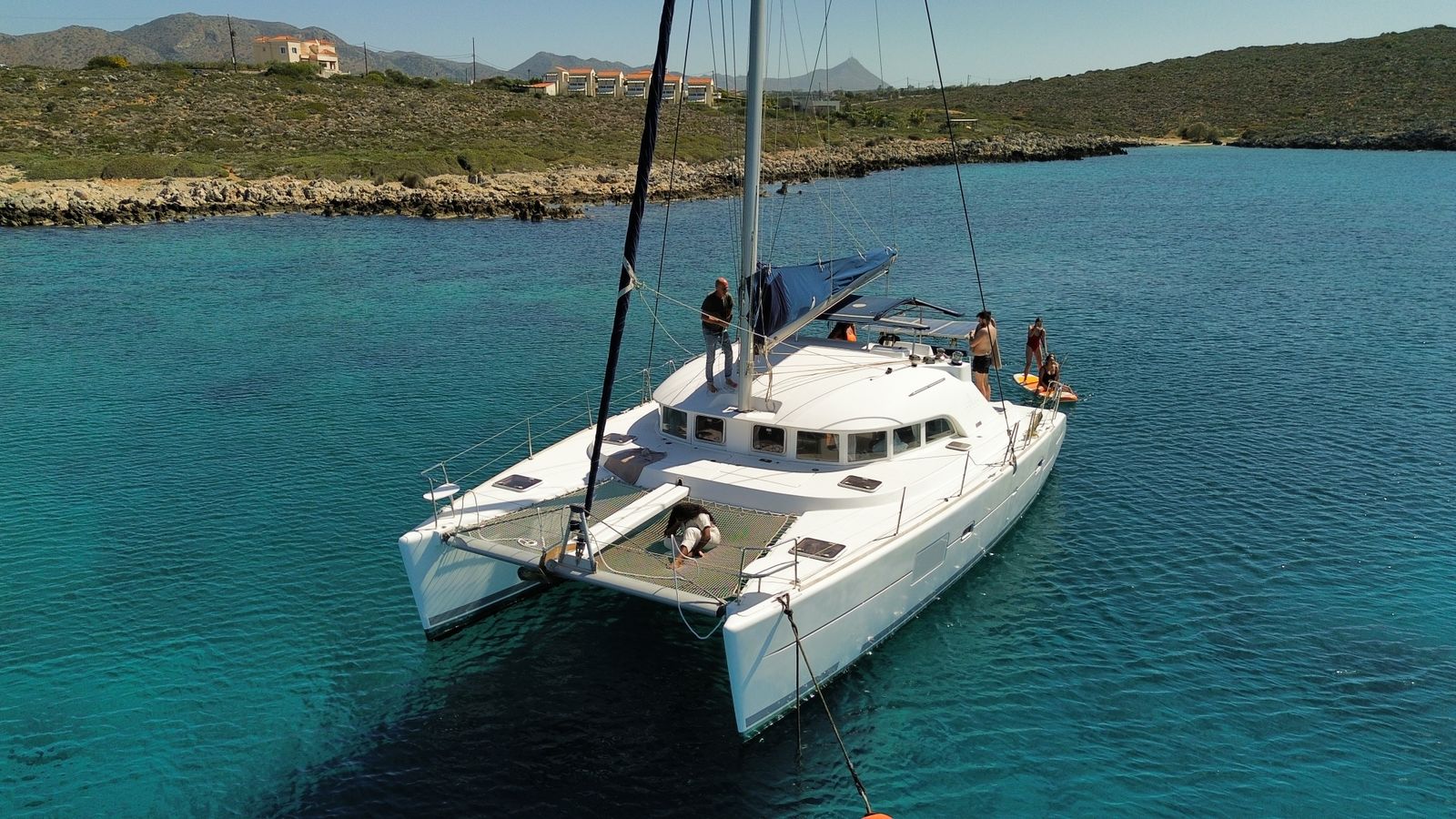
Catamaran. Two hulls joined by a wide bridgedeck, usually sailed rather than motored. The twin-hull design barely heels, which makes it the most stable-feeling platform of the three, and the wide beam creates exceptional living space for the length. Most charter catamarans are 40 to 60 feet and sleep 8 to 10 guests in four or five cabins.
Motor yacht. A single-hull vessel driven entirely by engines, from 60-foot flybridge yachts to superyachts over 130 feet. It trades fuel for speed and volume: the fastest way between anchorages, with the most interior space and the largest crews. Charter motor yachts typically sleep 8 to 12 guests.
Sailing yacht (monohull). A single-hull yacht driven primarily by sail, usually 40 to 55 feet on the charter market. It heels in wind — part of the appeal for sailors, part of the adjustment for everyone else. Cabins are narrower than a catamaran of the same length, but the sailing experience is the point.
Space and comfort
For groups, usable space per person is the metric that matters, and catamarans win it decisively. The bridgedeck of a 50-foot catamaran offers a saloon and cockpit roughly equivalent to a much larger monohull, plus four near-identical double cabins — no one gets the bad cabin, which removes the most common group friction. Cabins on sailing monohulls narrow toward the bow and stern; someone always draws the short berth.
Motor yachts counter with a different kind of comfort: full standing headroom throughout, stabilisers that flatten the motion at anchor and underway, and volume for amenities — gyms, cinemas, beach clubs — that the other two cannot fit. On vessels over 100 feet the comparison stops being close; below 80 feet, a large catamaran often feels roomier than a motor yacht of similar price.
Cabin layouts deserve a closer look because brochures flatter them. On catamarans, expect four or five genuinely similar double cabins, each usually with its own bathroom — the layout that makes splitting costs feel fair. Sailing monohulls typically offer three or four cabins, with the forward V-berth and aft cabins differing noticeably in space and privacy; ask for the cabin plan before assigning berths. Motor yachts in the 60 to 80-foot range usually carry four or five cabins including a full-beam master suite, a meaningful step up in privacy for couples travelling with friends. Whatever the type, confirm the number of bathrooms as well as cabins: two couples sharing one bathroom will feel it by day three.
Motion comfort also differs. Catamarans barely heel but can have a quick, snappy motion in certain seas. Sailing monohulls heel steadily, which most people adapt to within a day. Motor yachts, especially stabilised ones, are the calmest platform overall — relevant if anyone in the group is prone to seasickness.
Speed and range
This is the motor yacht’s home turf and there is no contest. Typical cruising speeds are 15 to 25 knots for a motor yacht, 6 to 10 knots for a catamaran under sail, and 6 to 9 knots for a sailing yacht.
The practical consequence is itinerary range. A motor yacht can cover in a morning what takes a sailing yacht all day, which matters on island chains with long passages — the Balearics, the Cyclades, the Exumas. If your group wants three islands in a week with lazy mornings, the motor yacht makes it possible; under sail, the same plan becomes a delivery trip. Conversely, if the plan is short hops and long anchorages, the speed advantage buys nothing and you pay for it in fuel.
Shallow draft is the catamaran’s quiet advantage: typically 4 to 5 feet versus 6 to 9 for monohulls and more for large motor yachts. That means closer approaches to beaches and anchorages the others must tender into.
One more practical note: speed costs noise as well as fuel. A motor yacht at 20 knots is louder underway than a sailing yacht at 7, which matters on long passages if anyone in the group is a light sleeper or hoping to work during the day. Catamarans under engine sit in the middle — quieter than a planing motor yacht, louder than a yacht under sail.
Running costs and APA
Fuel is where the three types truly diverge in cost. A motor yacht at cruising speed can burn hundreds of litres per hour; a sailing yacht or catamaran under sail burns a fraction of that. This flows directly into the APA (Advance Provisioning Allowance — the running-cost deposit explained in our yacht charter cost guide).
One published charter guide puts APA at about 35% of the base fee for motor yachts and superyachts, but nearer 25% for many crewed catamarans (source: LuxuryCharterGroup, accessed 13 October 2026). A 2026 listings analysis found the same pattern from the other direction: of 156 Bahamas motor yachts tracked, 152 charter on plus-expenses terms with APA measured at 30 to 40% of base rate, while 29 of 34 sailing catamarans were all-inclusive with no APA at all (source: Vital Charters, verified August 2026).
Note
All-inclusive does not mean everything is free — crew gratuity, charter taxes and anything you do ashore are still extra. It means the yacht’s own running costs are bundled into the headline rate, which makes budgeting far simpler.
Price bands
Published 2026 data lets us compare like with like. The figures below are advertised base rates per week; remember that motor yachts then add APA, tax and tip on top, while many catamarans bundle most of it.
Indicative weekly base rates by yacht type, 2026
Yacht type
Indicative base rate per week
Pricing model
Crewed sailing catamaran
Median about $31,500 (middle half $24,500-$43,000)
Often all-inclusive
Crewed power catamaran
Median about $42,210
Often all-inclusive
Crewed motor yacht
Median about $118,800 (middle half $77,400-$168,800)
Plus expenses: add 30-40% APA, tax, ~10% tip
Bareboat catamaran (no crew)
About $5,700 to $10,000
Plus fuel, marinas, damage deposit
Indicative figures. Source: Vital Charters 2026 listings analysis (670 crewed yachts tracked). Data collected: 13 October 2026.
The Caribbean market shows the same shape at a smaller scale: a week on a crewed catamaran at $15,000 to $25,000 with two crew and most costs included, versus $35,000 to $80,000+ for a crewed yacht with three to six crew (source: YachtCharterSunlimited, accessed 13 October 2026).
Per-person arithmetic makes the gap concrete. Published worked examples for eight guests: a catamaran in Greece at 14,350 euros base plus 12% VAT and 30% APA totals 20,377 euros — about 2,547 euros per person for the week. A motor yacht in the Balearics at 27,000 euros base plus 21% VAT and 30% APA totals 40,770 euros — about 5,096 euros per person. A larger motor yacht in the Cyclades reaches 79,040 euros all-in, or about 9,880 euros per person (source: West Nautical, accessed 13 October 2026).
Which suits which group
Choose the catamaran if: the group is 6 to 10 people splitting the bill; anyone is new to sailing or nervous about heeling; beach access and shallow anchorages matter; you want the simplest budgeting (all-inclusive terms are common); the itinerary is short hops, not long passages.
Choose the motor yacht if: the itinerary demands speed — long distances, many islands, limited days; the group values onboard amenities and stabilised comfort over sailing; the budget comfortably absorbs 30 to 40% APA on top of a higher base rate; anyone in the group struggles with motion.
Choose the sailing yacht if: sailing itself is the point — the group includes sailors who want to helm, trim and heel; you want the lowest fuel bill of the three; the group is smaller (6 to 8) and happy with cosier cabins; quiet anchorages under sail appeal more than covering distance.
One structural fact applies to all three: crewed charter yachts are generally capped at 12 guests, so groups larger than that need to think about multiple yachts or a different format (source: Vital Charters, accessed 13 October 2026).
Tip
Decide the itinerary before the yacht type. Write down the three longest passages on your planned route — if any exceed about 40 nautical miles, price a motor yacht seriously, because the sailing options will spend the trip catching up.
Whichever type you choose, the money mechanics are the same: base fee, APA, tax and tip. Our guide to how charter brokers get paid explains who earns what from your booking, so you can read any quote with clear eyes.
Frequently asked questions
Is a catamaran cheaper to charter than a motor yacht?
Usually yes, per week and per person. A 2026 listings analysis put the median crewed sailing catamaran at about $31,500 per week all-inclusive, versus about $118,800 for a crewed motor yacht before APA, tax and tip are added.
How many guests can each type take?
Crewed charter yachts of every type are generally capped at 12 guests. Within that limit, catamarans typically sleep 8 to 10 in four or five cabins, motor yachts 8 to 12, and sailing yachts 6 to 10.
Which is fastest: catamaran, motor yacht or sailing yacht?
Motor yachts, by a wide margin — typically 15 to 25 knots versus 6 to 10 for sailing yachts and catamarans under sail. If your itinerary covers long distances, the motor yacht saves whole days.
Do catamarans have lower running costs?
Yes. One published charter guide puts APA at about 35% of the base fee for motor yachts and superyachts but nearer 25% for many crewed catamarans, reflecting much lower fuel burn. Caribbean catamarans are also often quoted all-inclusive, with no APA at all.
Which type is best for a family with children?
Catamarans are the usual recommendation: level sailing with minimal heeling, shallow draft for beach access, and the most deck and cabin space per dollar. Motor yachts suit families that prioritise speed and onboard amenities.
Sources and method
We compared published rates and guides from the sources below. Figures are indicative ranges, not quotes, and were collected on the dates shown with each source.
This guide is general information, not professional advice. Prices are indicative and change with season, route and availability. Spotted a mistake? Our contact email is coming soon.