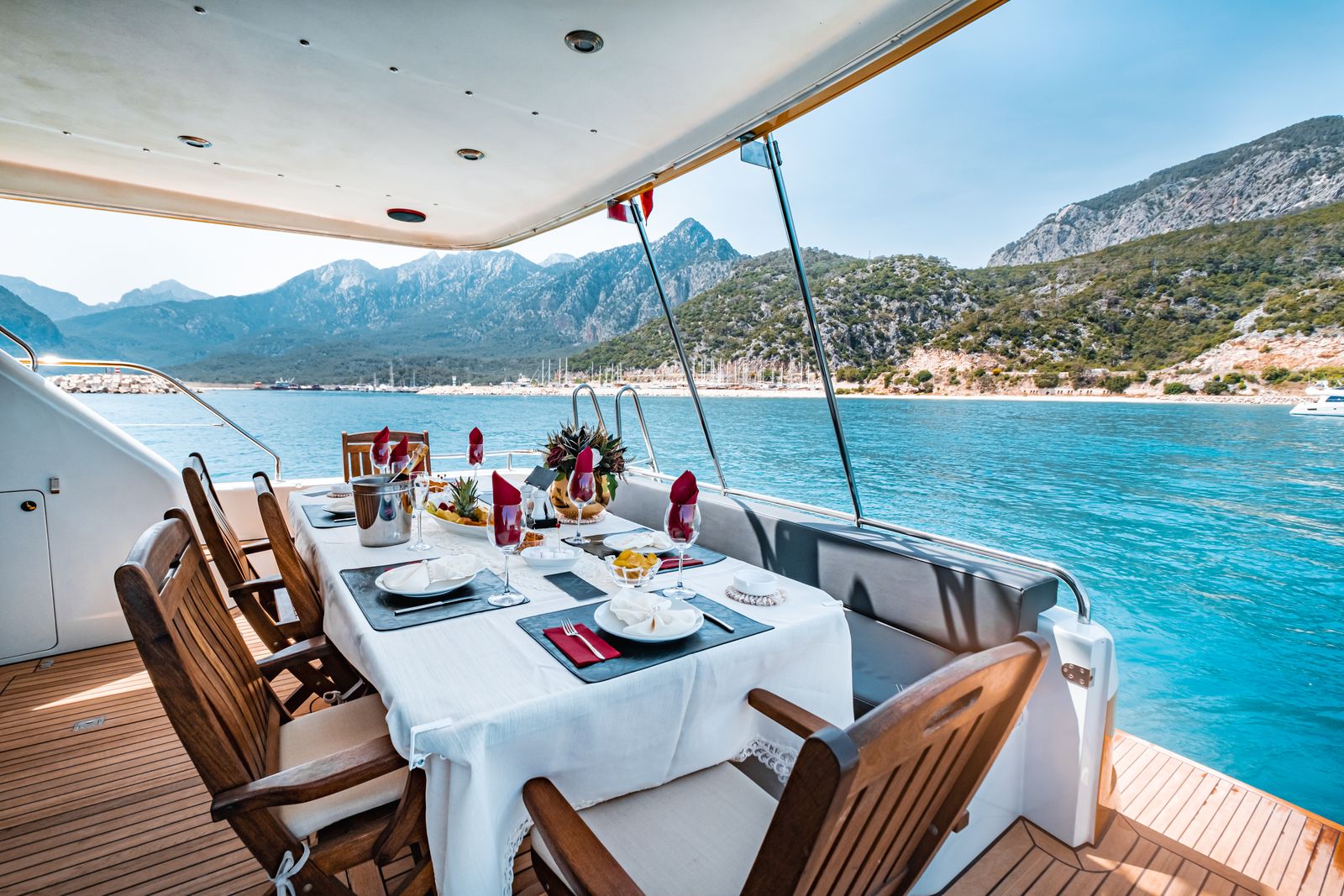
Yacht Charter for Birthdays, Weddings and Corporate Events
By The Charter Cost Guide editorial team · Updated October 13, 2026 · 8 min read
Some links on this page are affiliate links. We may earn a commission at no extra cost to you. Read how we make money.
Short answer
A yacht event charter is priced as a vessel rate plus catering minimums and extras, not per person. Published 2026 operator examples range from about $2,400 for a 64-foot vessel to $4,500 for a large evening event vessel, with food-and-beverage minimums from $1,500. The three things that decide whether your event works are the legal guest limit for the specific vessel, what the catering and music rules allow, and a written weather backup plan.
A yacht turns a birthday, wedding or company event into something guests remember. It also adds a layer of logistics that a hotel ballroom never has: the venue moves, the guest count is legally capped, the kitchen is a galley, and the weather gets a vote. This guide walks through how event charters are priced, the rules that catch planners out, and a timeline you can follow from first enquiry to boarding.
If you have never chartered before, read our first-timer’s guide first, then come back — the basics of how charter pricing works are covered in our yacht charter cost guide.
Day charter vs multi-day
Most events use a day charter: 3 to 6 hours aboard, often a late-afternoon departure with a sunset cruise built in. A 2026 wedding planning guide describes the four-hour reception as the typical format — boarding and welcome drinks, dinner timed to sunset, speeches and cake under twilight, then dancing on the return leg. Day charters are priced as a vessel rate for the time block, plus catering minimums and extras.
A multi-day event charter is a different product: the yacht becomes a floating hotel for a wedding weekend or a corporate retreat. Pricing follows the weekly charter model (base fee plus APA, taxes and tip) rather than the event-package model, and guest capacity rules apply per cruising day. For most birthdays and company parties, the day charter is the right shape; consider multi-day only when guests genuinely need to sleep aboard.
Note
Never assume a vessel hosts events just because it charters. Event use — amplified music, outside caterers, large groups — needs the operator’s explicit confirmation for that specific yacht and date. Get it in writing.
Guest capacity and licensing
This is the section that matters most, because it is where event plans most often break. Every commercial vessel has a certified passenger limit, and that limit is a legal ceiling, not a suggestion. Ask the broker for two numbers: the certified limit while cruising, and the limit while dockside — published planning guides note these can differ, with the dockside figure sometimes higher.
Do not work backwards from your guest list to a vessel. Work forwards from certified vessels to your guest list. A few practical points:
Reception vs seated capacity differs. One published 2026 operator example lists a vessel at up to 100 guests reception-style but only 48 seated; a 64-foot vessel at up to 40 reception but 25 for buffet dining. Decide your dining format before you shortlist vessels.
Crew count against the limit. Ask whether the stated capacity includes crew or is guests-only.
Permits vary by location. Some ports and event types need local permits for gatherings, amplified sound or fireworks. Ask the broker which permits apply to your plan and who arranges them.
RSVPs need a hard deadline. A hotel can squeeze in late additions; a vessel at its certified limit cannot. One wedding guide recommends invitations carry a boarding time at least 30 minutes before actual departure, because a boat cannot wait for latecomers once the lines are off.
Catering and music rules
Catering is usually the largest variable cost after the vessel itself, and the rules differ more than first-timers expect. Published 2026 operator examples show food-and-beverage minimums starting at $1,500 on smaller event vessels, and $4,000 (or $35 per person) for daytime or $4,500 (or $42 per person) for evening events on a large vessel — with food, beverages, gratuity, landing fees and tax additional in that package.
Sample published event charter packages, 2026
Vessel example
Starting charter rate
Food & beverage minimum
Indicative capacity
64-foot event vessel
From $2,400
From $1,500
Up to 25 buffet / 40 reception
Mid-size event vessel
From $3,700
From $1,500
Up to 48 seated / 100 reception
Large vessel, daytime
From $3,000
From $4,000 or $35 per person
Up to 340 plated
Large vessel, evening
From $4,500
From $4,500 or $42 per person
Up to 340 plated
Indicative figures. Source: 2026 private yacht charter cost guide (Drivepedia). Data collected: 13 October 2026.
Three questions decide your catering budget: can you bring an outside caterer, is there a corkage fee for your own alcohol, and does the galley fee apply if you do? Some operators welcome outside caterers; others require in-house catering with no exceptions. There is no industry standard — the vessel’s policy is the only one that counts.
Music rules need the same directness. Ask whether amplified music is allowed while cruising, what the marina’s quiet hours are, and whether there is a hard cutoff time. A DJ who has to stop at 10 pm changes the shape of your evening; find out before you hire one.
Weather and backup plans
Weather is the one vendor you cannot negotiate with. Every event charter needs a written backup plan agreed before money changes hands. The common options:
Reschedule to another date, subject to availability.
Dockside event — the party happens aboard while the vessel stays at the pier.
Partial cruise — a shorter or sheltered route instead of the planned itinerary.
Cancellation under the contract’s weather clause.
Ask who makes the call and when. If the operator decides at noon for a 4 pm departure, your vendors need to know that timeline too. Also ask what happens to catering already prepared and deposits already paid under each scenario — the answers differ, and “we’ll work something out” is not a policy.
Tip
Put the weather decision time in your vendor contracts. Your caterer, photographer and musicians should all know the hour by which a go/no-go decision is made, so nobody is setting up for an event that moves.
Budget items to ask about
Event charter quotes hide costs in the gaps between vendors. When comparing operators, ask for each of these as a line item:
Vessel rate — and exactly which hours it covers, including boarding time.
Catering and beverage minimums — plus service charges and gratuity on top.
Crew overtime — what happens if the event runs long, per half hour.
Docking and landing fees — sometimes included, sometimes not.
Décor setup and teardown — who does it, when, and at what cost.
Entertainment power needs — DJs and lighting rigs may need the vessel’s generator specs confirmed in advance.
Cleaning fees — event clean-up is rarely the standard turnaround clean.
Taxes — added on top in most regions; confirm the rate.
Photography/videography restrictions — drones especially may need separate permission.
Our hidden costs checklist covers the general charter extras — APA, delivery fees, deposits — that apply on top of the event-specific items above.
Event planning timeline
Use this as your working schedule. Adjust the lead times to your event size: weddings and 100-guest corporate events need the full runway; a 20-person birthday can compress it.
8 to 12 weeks out: Fix the guest count range and total budget. Shortlist vessels by certified capacity, not by photos. Ask every broker the capacity, catering and music questions from this guide.
6 weeks out: Confirm the vessel and sign the contract. Lock the catering format (in-house vs outside, alcohol policy). Identify any permits and who arranges them.
4 weeks out: Send invitations with a boarding time at least 30 minutes before departure. Brief vendors on the vessel’s constraints: galley size, power, load-in times, noise cutoff.
2 weeks out: Final headcount to the caterer. Confirm entertainment, décor plan and photography permissions. Reconfirm the weather policy and decision time with the operator.
1 week out: Watch the forecast. Confirm final timings with all vendors. Prepare a guest information note: meeting point, parking, boarding time, footwear guidance (many yachts ask guests to avoid heeled shoes on deck — confirm the vessel’s policy).
Day before: Reconfirm the operator, the boarding time and the weather call time. Charge phones, print the contact list.
Day of: Arrive early. Do the safety briefing with the crew before guests board. Then hand the schedule to your planner or a trusted friend and enjoy it.
Questions to ask the broker before you book
Copy these into your first email. A broker who answers all ten clearly is worth working with.
What is the certified guest limit for this vessel, cruising and dockside?
Are any local permits needed for our event type, music or décor plans — and who arranges them?
Can we use an outside caterer, and what are the corkage and galley fees?
What are the music rules: amplified sound allowed, quiet hours, cutoff time?
What is the written weather backup plan, and who decides, by what time?
What exactly is included in the vessel rate, and which hours does it cover?
What is the crew overtime rate if the event runs long?
What are the payment schedule and cancellation terms, in writing?
Whose insurance covers guest injury during the event?
Can we do a walkthrough of the vessel before signing?
Frequently asked questions
How far in advance should I book a yacht for a wedding or event?
For weddings and large corporate events, start 8 to 12 weeks out: the vessels licensed for bigger groups are fewer and book early in peak season. Smaller birthday charters can often be arranged 2 to 4 weeks ahead, but popular weekend dates still go first.
Can I bring my own caterer and alcohol on a charter yacht?
Sometimes. Policies vary by operator and vessel: some allow outside caterers with a corkage or galley fee, others require their in-house catering. Ask before you book, because this single rule can move your budget by thousands.
What happens to my event if the weather is bad?
Reputable operators have a written weather policy: typically rescheduling to another date, a dockside event without cruising, or cancellation terms spelled out in the contract. Get the exact policy in writing before you pay a deposit.
How many guests can a charter yacht legally carry?
It depends on the vessel's certification, which sets a legal passenger limit. Ask the broker for the certified limit for cruising and for dockside use — they can differ — and never assume one vessel's limit applies to another.
Are there noise or music restrictions on yacht events?
Often yes. Marinas and local authorities may set quiet hours, and some vessels restrict amplified music while cruising. Confirm the music rules, permitted hours and any cutoff time in writing.
Sources and method
We compared published rates and guides from the sources below. Figures are indicative ranges, not quotes, and were collected on the dates shown with each source.
This guide is general information, not professional advice. Prices are indicative and change with season, route and availability. Spotted a mistake? Our contact email is coming soon.